Many people think that having a child means you have to stop traveling. Fortunately, this is not the case at all. In this guest post, Kristin Addis from Be My Travel Muse and Parenthood Adventures shares her tips on flying with a baby so you can travel with confidence the next time you take a flight.
Flying with a baby can be frightening. The thought of an entire plane full of people staring at them while their child sobs discourages many parents from taking their child on a trip.
As the mother of a well-traveled one-year-old, I have been on several flights where everyone complimented my child’s behavior and others when I was carrying a fussy, writhing child and counted down the seconds until the trip ended.
Those successes and failures have taught me a lot about how to make a long flight with a newborn more tolerable.
After visiting ten countries and taking about 100 flights as a family (plus some alone with my child), I have learned the following about flying overseas with a baby:
1. Get Your Documents in Order Prior to Booking
Before traveling internationally, ensure you’ve left enough time to get your baby a passport. First, you’ll need a birth certificate, and depending on where you live, this could take a while.
Next, take photos of your child lying on a white background (I used a T-shirt) and make your passport office appointment, where you’ll submit your application forms (available online and at the office), photos, and payment. Check your local passport office or post office for the required documents and procedures.
Make sure that you leave plenty of time to spare for processing the application. Consider expediting it if there’s a long wait or if you plan to travel in a week’s time (in which case, go in person). It took us about three weeks to get the appointment, and six more to get the passport (even with expedited processing).
2. Make Sure Baby Has a Ticket
Even if your infant will be on your lap, they still need to be ticketed to be allowed to board. For international flights, you’ll have to pay the taxes, and usually 10% of the adult fare, even if they’re just on your lap.
Make sure you have this ticket confirmation prior to heading to the airport. I have run into issues before, when the airline said my son was added to my reservation when in fact he wasn’t, causing me to miss my flight while we sorted out the extra ticket and fees. Now, I make sure I have the actual ticket confirmation to avoid any issues.
3. Reserve a Bassinet
A common misconception is that having a child implies you have to give up travel. Thankfully, this is completely untrue. Kristin Addis from Parenthood Adventures and Be My Travel Muse offers advice on flying with a baby in this guest post so you can travel with confidence the next time.
It can be terrifying to fly with a baby. Many parents are deterred from taking their child on a trip by the idea of an entire plane full of strangers gazing at them as their youngster tears.
As a mother of a well-traveled one-year-old, I have been on a number of flights where everyone praised my child’s behavior and others when I had to count down the seconds until the journey ended while carrying a fussy, writhing child.
I have learned a lot from those triumphs and setbacks about how to make a lengthy flight with a newborn more bearable.
I have learned the following regarding traveling abroad with a baby after traveling to ten countries and taking roughly 100 flights as a family (plus some alone with my child):
4. Get Toddlers Their Own Seat for Longer Flights
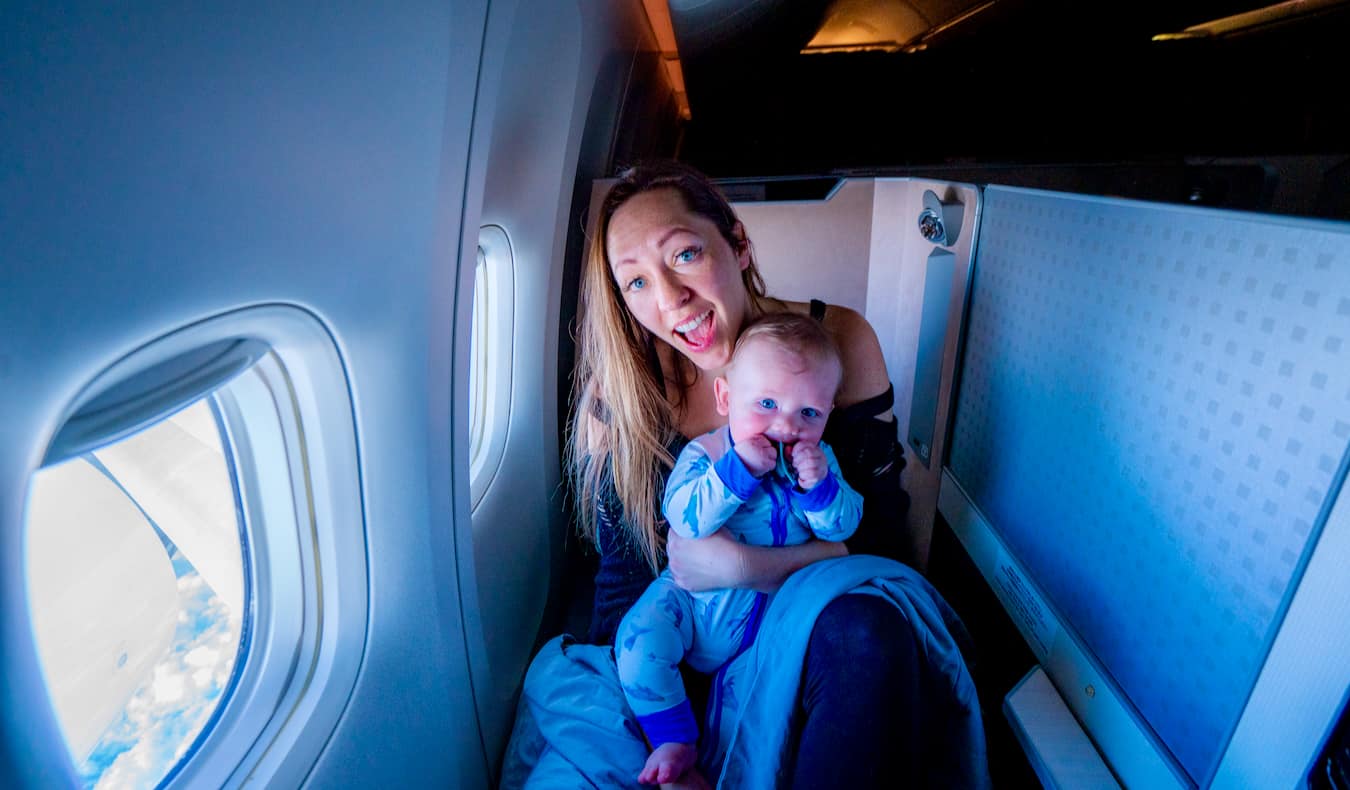
Children under two can fly on your lap (usually for free or for a discount, as mentioned above) instead of in their own seat, but on lengthy international flights, it’s well worth booking a separate seat for them. If they’re mobile, they’ll be squirming and encroaching on the space of the people next to you if they don’t have their own seat and will probably be frustrated that they can’t move around more.
Though we didn’t do this for my baby before he was standing and crawling, on our most recent flight, from Cape Town to San Francisco, which involved 24 combined hours in the air, it was our saving grace. Having our own row gave my son space to move, stand, climb a bit, and get his energy out. It also gave us more legroom and a space for him to sleep. It was so worth the expense.
If you do this, you’ll need to either bring a car seat or CARES harness onboard for them. A CARES harness wraps around the seat, creating a better-fitting seat belt situation, but they are only usable for babies who can sit up comfortably unaided, are over 3 feet (1 meter) tall, and weigh 22-44 lbs (10-20 kg).
5. Reserve a Meal for Them
Some airlines provide toddler meals as well as infant meals like purees. Emirates even has formula on board, despite the fact that it is an uncommon offering!
If your child has any dietary restrictions or allergies, let the airline know in advance. Special requests are frequently fulfilled by airlines, guaranteeing your child a healthy and secure meal while in flight. Since babies eat on their own timetable and you never know what the meal may contain, I always take our own food and snacks.
Do not rely on the airline to give your infant milk. While some have milk on board, we have discovered that others are not really ready with extra for infants and young children, and some may not have any at all. As he gets older, I have begun bringing powdered fortified oat milk sachets, or we bring our homemade plant milk in smaller containers (see below for quantities). There is also toddler formula!
6. Print Their Boarding Pass
Even though parents can use mobile boarding passes, I’ve always been required to show a printed ticket for our baby, even as a lap infant. From time to time, the ticketing agents have not realized this and said we could use a mobile ticket, but TSA, at least in the US, may require the printed ticket to get through security. While you’re checking in at the kiosk, just ask for printed tickets to avoid any headache.
7. Leave Extra Time at the Airport
Give yourself more time at the airport than you ever did before when traveling with a baby. Diaper changes, blowouts, extra time in security, and impromptu feedings can all happen, and having a comfortable buffer before your flight leaves is essential. It also allows for a more leisurely airport experience, ensuring that you don’t start off the whole trip rushed and stressed. You may have been able to sprint to a closing gate in the past, but that’s going to be difficult with a baby and all the extra luggage that entails!
8. Be Aware of TSA Regulations
As a parent, dealing with security is a completely new experience that will require more attention. Learn about the rules pertaining to traveling with a child and be aware of your rights. For the most recent information, visit the TSA website if you are leaving the United States; if you are traveling abroad, visit the website of your home country. Regulations are subject to change.
The most crucial information is that, depending on the agent, “acceptable” amounts of formula, breast milk, juice, water, and infant food are permitted over the 3 oz./100ml limit. Only once, and only in the United States, have I been questioned. We rarely receive further checks overseas when the agents are aware that the liquids are intended for a newborn. In South Africa, we even managed to get through security with an entire carry-on full of oat milk.
You will, however, be subject to further checks when passing through US security. If there is powdered formula in the bag, they may bomb-test it, put any liquids through an additional scanner, or even remove the lid to conduct a vapor test. Even with TSA Precheck, this could take an additional five to twenty minutes.
9. Learn How to Survive the Airport and Layovers
After security, we’re usually on the lookout for a family bathroom (so we can all go in) for a diaper change, followed by finding a quiet area to let the time pass. If you have a toddler, locate family-friendly amenities, such as play areas, where your child can expend some energy. I like to research this before we even get to the airport, so we know where we’re going.
Remember to have a stroller that can fit in the overhead bin of an airplane or baby carrier for easy transport in the terminal. I prefer smaller strollers, so that I don’t risk them getting damaged through gate-checking and don’t have to wait after the flight to get the stroller if it’s a tight connection, which happens all the time when there are delays.
However, if your stroller is too large to be a carry-on, you can usually gate-check it for free. I have yet to come across an airline, including low-cost carriers, that don’t do this.
If your baby needs to move, let them crawl. Yes, the floor is dirty, but you can always wash their hands and change their outfit before boarding.
10. Keep Them Entertained
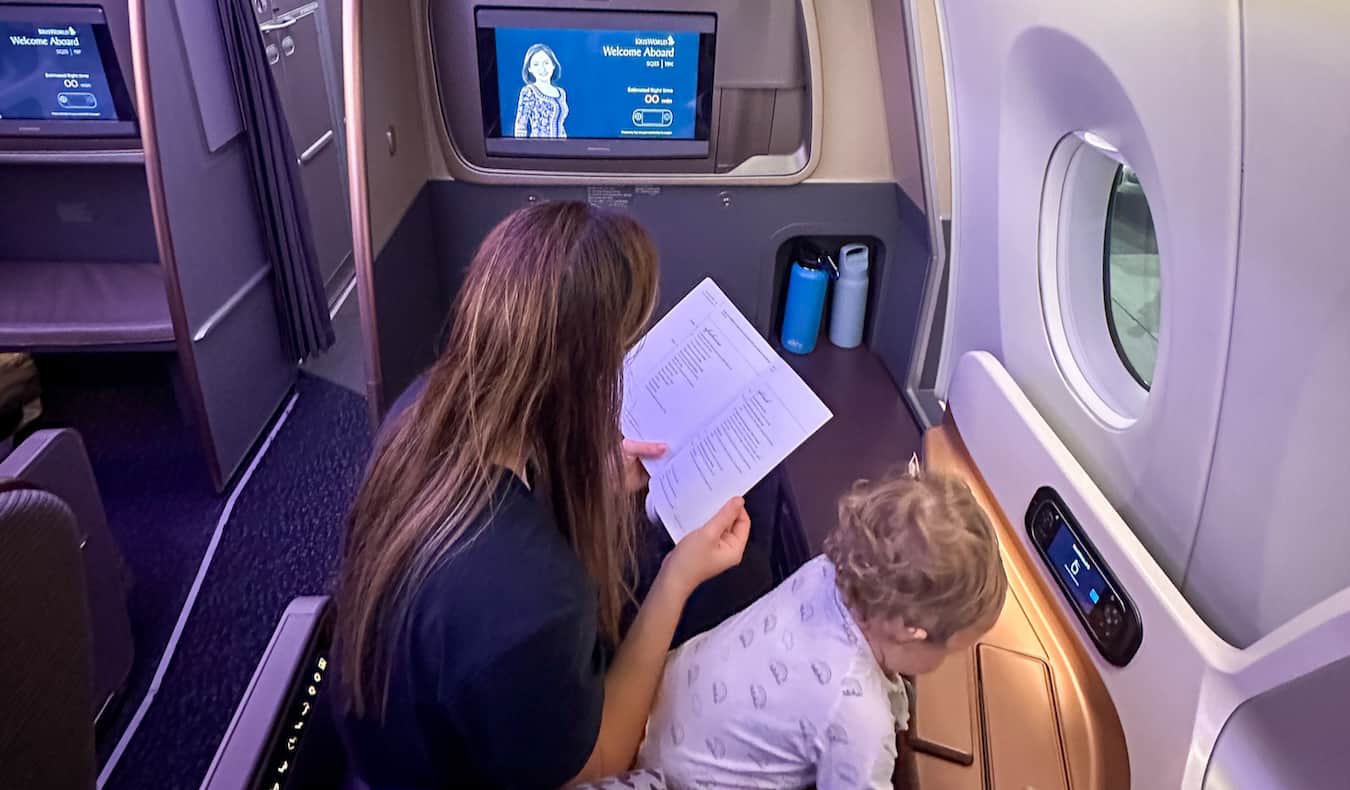
In your diaper bag (which doesn’t count against carry-on allowance), pack a variety of entertainment options for your baby. We like to stick spinners to the plane windows and bring small object permanence boxes, little books, and stickers. Most airlines have had little toys as well, though I wouldn’t count on those being your main source of entertainment. Never underestimate the power of reading a book, playing peek-a-boo, or giving your child a water bottle to play with.
Although we’ve never done this, I’m not here to judge you if you download some Ms. Rachel on your phone or tablet before leaving home. Just keep in mind that you’ll have to either play it without sound or get your toddler baby-sized headphones for the full experience.
11. Pack Finger Foods for the Flight
Making sure my baby is nourished and content with meals that need some effort to prepare is another way I kill time. You should always pack finger foods that your child likes, such as Cheerios, mashed blueberries, smoothie melts, quartered grapes, and other non-messy fruits or vegetables. You can begin baby-led weaning as early as six months of age. Bring pouches that do not require refrigeration if you are making purees.
Remember that most nations do not let outside fruits and vegetables through customs, so you will need to finish any produce before arriving at your destination.
12. Prepare Your Carry-On
Make sure you have adequate diapers, wipes, pacifiers, and extra clothing for any delays in your carry-on bag. Even though we often pack many more diapers than we anticipate using, we frequently use them all when there are delays or an upset stomach. We have also changed into four different outfits. Most airlines do not carry diapers and wipes on board, and they can be hard to find in the terminal.
Remember to pack additional clothes for yourself as well, since travel can occasionally result in unforeseen messes. Keep a small first-aid kit with any prescriptions your infant may require, such as painkillers, fever suppressants, or allergy treatments. The worst is not having things on board when you need them and wishing you had them.
Put over-the-counter liquids in smaller containers before traveling because TSA will impose liquid limitations on pharmaceuticals unless you have a prescription.
13. Understand Stroller Policies
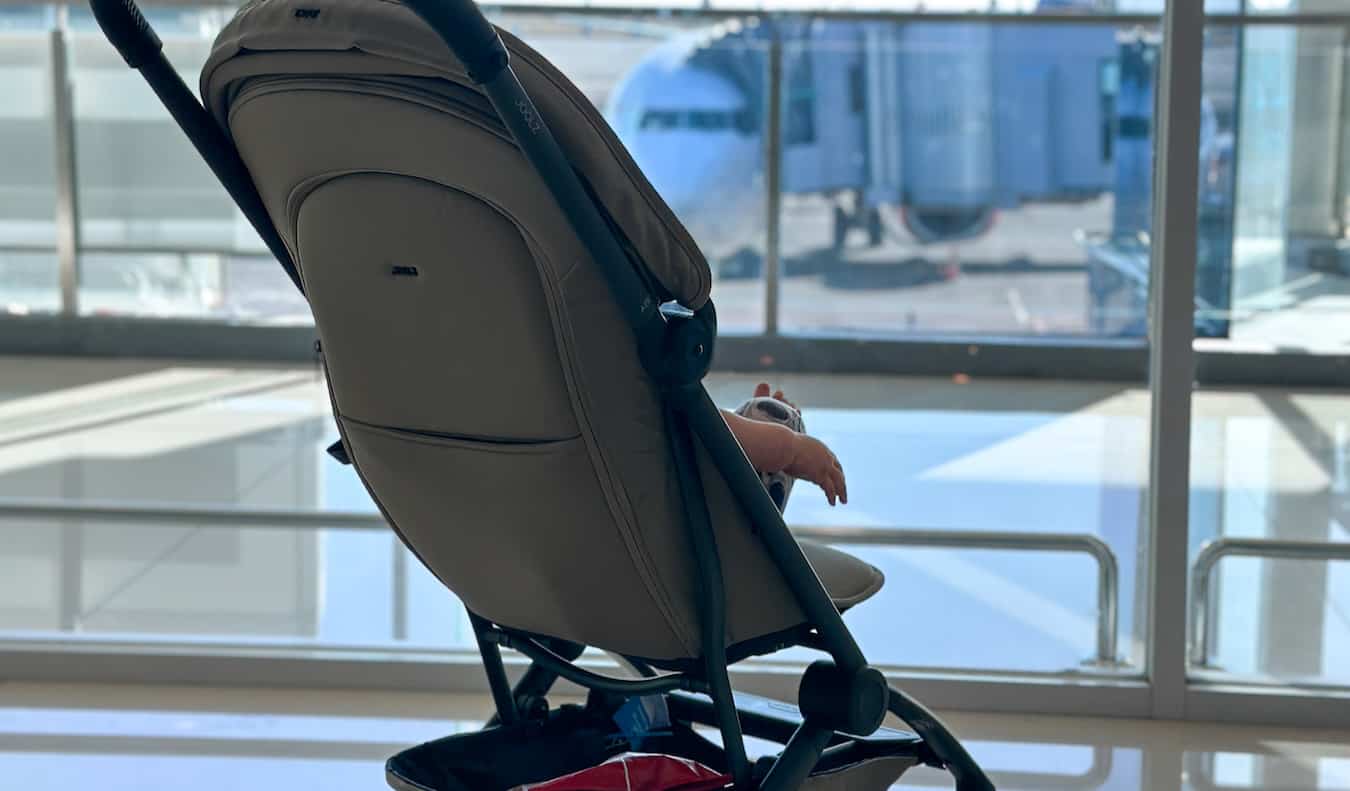
Thankfully most airlines do not count a stroller or car seat against your checked baggage allowance if you choose to check your stroller or car seat. I also have yet to find an airline that doesn’t allow parents to gate-check strollers, meaning you can use them in the airport until you board the plane. This convenience can make navigating the airport much more manageable.
If you can’t gate-check your stroller, many airports have free ones you can use while you’re at the airport.
14. Review the Car Seat Policies
If you’re traveling with a car seat, you have the option of checking it as hold luggage, bringing it to the gate, or bringing it onboard if your baby has their own seat. If you do check it as hold luggage, as mentioned above, it usually does not count against checked luggage limits, even on low-cost carriers. If you plan to check both a stroller and a car seat, check with the airline, as some only allow one.
You’re rolling the dice a bit checking a car seat, because if it gets lost, you could show up to your destination without it. We’ve still gone for it, though, knowing the risk, in order to have less to juggle in the airport, but it’s important to keep that in mind just in case.
If you plan to bring the car seat onboard, make sure it’s FAA-approved for air travel. I loved our Uppababy Mesa, and the Nuna Pipa is great too.
15. Know the Baggage Policies
Traveling with children often means more luggage, so be prepared for potential extra baggage fees. Familiarize yourself with the weight and size restrictions to avoid surprises at the check-in counter. Some airlines will give a baby some checked baggage allowance, but most don’t unless the child has their own seat.
We have yet to manage to go carry-on only since having a baby. We’re usually traveling with his foldable bed, travel high chair, and extra food for him. Thankfully most baggage is included without extra fees for international flights, with the exception of low-cost carriers.
Carry-on strollers and diaper bags have never been counted against our allowance.
16. Clear Their Ears Before Takeoff and Landing
During takeoff and landing, changes in cabin pressure can cause discomfort for everyone, but babies don’t know yet how to clear their ears. To help alleviate this, breastfeed, or offer a bottle, pacifier, or even a snack that encourages swallowing. By making sure we do this for every takeoff and landing, we’ve been able to avoid crying due to ear pressure issues.
17. Know How to Clean Things Onboard
If you’re on a long flight, you’ll eventually need to clean a bottle or maybe even a breast pump. I like to bring a small, 2–3 oz. unscented soap container and a portable bottle washing station. Ask the flight attendants for clean water for washing. I’ve had them sometimes even offer to rinse a bottle out for me with hot water.
18. Keep Nap and Sleep Times Consistent
Crossing several time zones is a common part of international travel, which can cause jet lag in both you and your child. Make sure you stick to your usual bedtime and nap schedule as much as possible while flying to help lessen its affects. To adjust more quickly, follow the local timetable when you first arrive.
One of the main concerns for parents is jet lag, but my son usually adjusts faster than I do, and I have always been impressed!
19. Dress Your Baby Comfortably
Dress your child in comfortable, breathable clothing for the flight. Opt for layers, as the temperature on the plane can vary. We always put my son in bamboo baby clothes, which are great for temperature regulation, and, having worn the adult versions myself, I can vouch that it’s like wearing a cloud. In a dry environment like an airplane, having some comfort is key.
20. Take a Walk
When there are not any food or drink carts nearby, make sure you get up and allow your child stroll up and down the aisles. If you have a gregarious child like mine, it can help them pass the time, release some energy, and give them a chance to wave at their devoted fans.
I have never personally experienced anything like that, even though there have been some well-publicized instances of travelers becoming agitated over wailing infants. Instead, I find that other passengers frequently play peekaboo or grin and wave at my son.
21. Be Mindful of Timing
When booking your flights, choose departure times that align with your child’s schedule as much as possible. Although it’s sometimes unavoidable, it sets us off on the wrong foot if I have to wake my son up for a flight well before he would naturally. He’s fussy and irritable, and he doesn’t always fall back asleep easily.
As for red-eyes or day flights, I’ve found that both work, but at least on a red-eye, he’s more likely to sleep for a good chunk of it, meaning I have to find fewer ways to entertain him.

22. Invest in a Good Baby Carrier
A comfortable baby carrier is a valuable asset when traveling with a child under two years. It allows you to have your hands free to manage luggage, documents, and other essentials while keeping them secure and close. We only traveled with a carrier until my son was about eight months old before switching to a stroller. That said, some destinations don’t have great sidewalks (I’m looking at you, Southeast Asia), so having a carrier is important, too. I have used both Ergobaby and Artipoppe and like both for different reasons: Artipoppe is more comfortable for the baby facing in, and Ergo baby is nicer facing outward.
23. Know Your Destination’s Regulations
Traveling with a child may be subject to different laws and procedures in different nations. Find out what paperwork, immunizations, or permits are required for your foreign destination.
When we checked in for our flight to South Africa in Namibia, we were required to present my son’s birth certificate, which startled me. I am delighted we have a copy with us when we traveled.
If you are traveling alone, you might need to present a copy of the birth certificate, a copy of the other parent’s passport, and a written consent from the other parent for you to take the child abroad. I was never asked for anything, even though Canada mentioned this as a prerequisite. Nevertheless, it is crucial to be ready for everything.
24. Plan for Delays
Delays can happen (over 20% of flights are delayed, in fact!), so it’s wise to be prepared for them. Pack enough supplies, including diapers, formula, snacks, and entertainment, to handle unforeseen delays. We encounter them all the time, and a well-stocked carry-on can make waiting at the airport more manageable. If you have a phone or tablet for your toddler, make sure you have an external battery to keep them charged.
25. Be Patient
It can be difficult to travel with a child, and there may be times when you are tired or frustrated. Throughout the trip, keep your composure and be patient. Your youngster will notice if you are extremely anxious and agitated. Making the experience fun for you and your child can be greatly enhanced by having a positive outlook and a sense of humor.
In the end, the secret to a successful international trip with a child under two is to embrace the adventure and accept that things might not go as planned. Make the most of the trip, celebrate the little things in life, and remember that it is acceptable if your kid is fussy. The flight is a necessary step to get to the vacation. They are free to soar and even cry if necessary because they are a part of civilization.
Making treasured memories with your child and treating yourself as a parent are worth the effort!